
Cass County Multi-Day Arrest Reports
The Cass County Sheriff's Office puts out no official 72-hour, seven-day, or weekly arrest log. For a multi-day picture of Cass County recent arrests, the best public option is the Journal-Courier news section. It runs recurring police-report and police-beat articles. These are journalism, not jail records. They don't refresh like a live roster. And they make no promise that every arrest gets a mention.
Past stories have grouped items under Cass County, Beardstown Police, and Virginia Police. Some entries name the charge, the arrest date, the arresting agency, and an outside jail that lodged the person. That layout helps you follow events across several days in Cass County. Still, be careful with dates. A story's publication date is rarely the arrest date. There is no fixed reporting window either. An item posted midweek may describe the prior weekend.
Read Cass County Police Blotters
Start your search with a date and an agency, not just a name. Cass County has no jail of its own, so an article may also name the facility that received the person. Keep that distinction in mind whenever you compare a news report against court or custody records.
- Open the Journal-Courier news archive and find police-beat or police-report stories near the event date.
- Look for a Cass County, Beardstown Police, Virginia Police, or other local-agency heading inside the article.
- Record the reported arrest date, alleged charge, agency, and lodging facility. Do not replace the event date with the article date.
- Confirm a current case through the Cass Circuit Clerk or Judici and request the arrest report from its creator when needed.
- For a very recent event, use the 24 Hour Arrests verification path instead of waiting for a news story.
The Journal-Courier Police Beat example shows how local entries get grouped. It also illustrates how an outside jail may be named in a Cass County arrest item.

A newspaper article is a dated secondary source. Confirm its details against the arresting agency's own record and any later court outcome.
Cass Arrest-Log Entry Fields
A Cass arrest-log entry can hold many fields. A booking date, a name, charges, a location. No fixed Cass template promises all of them appear each time. Treat a blank field as unknown until an official record fills it in. News reports also tend to summarize. The wording may drift from what the actual arrest report says.
| Reported field | How to interpret it |
|---|---|
| Name | Match carefully; a name alone is not enough to establish identity. |
| Arrest date | The event date can precede the date on which the article was published. |
| Arresting agency | This points to the likely custodian of the arrest report. |
| Alleged charge | It is an charge at that stage, not a conviction or final disposition. |
| Lodging facility | Morgan or Schuyler has appeared in old reports, but the current destination must be verified. |
| Photograph | The examined recurring reports are text-led; no Cass mugshot gallery or universal photo practice was found. |
The jail that took the person in may hold a booking number, a photo, or release details that the article never mentions. Old stories also linger in search results long after someone has left custody in Cass County. For how a case truly ended, the court file is the sound place to look.
Cass Weekend Reporting Patterns
Cass County has no set weekend or holiday posting schedule for arrest news. Local outlets often fold several incidents into a single report. That can bunch events from different days into one story. It looks like a surge. It is really just a publishing pattern. A quiet Monday article, by the same token, does not mean nobody was arrested that day.
The receiving jail updates its roster on its own cadence. A police agency writes its report, and a newsroom picks what runs. Court filings follow yet another timetable. Treat these as separate channels rather than one Cass feed, and use the county-wide recent-arrests source map to find which office holds the record you need.
For broader coverage across several days, the Journal-Courier news landing page is the natural starting point.

A news index can point you toward coverage of Cass County arrests. What it cannot do is confirm an official custody status or pin down a firm date range for any one arrest.
Cass Arrest Archives Beyond News
Old police stories sometimes survive online for years. Public examples from various years prove that. Still, this is not a complete archive of Cass County arrests. Articles vanish, links shift, and selective coverage leaves real gaps. For a historical path, the Illinois newspaper record for the Cass County Star-Gazette offers a solid lead. It is a newspaper resource, though. It is not a live blotter.
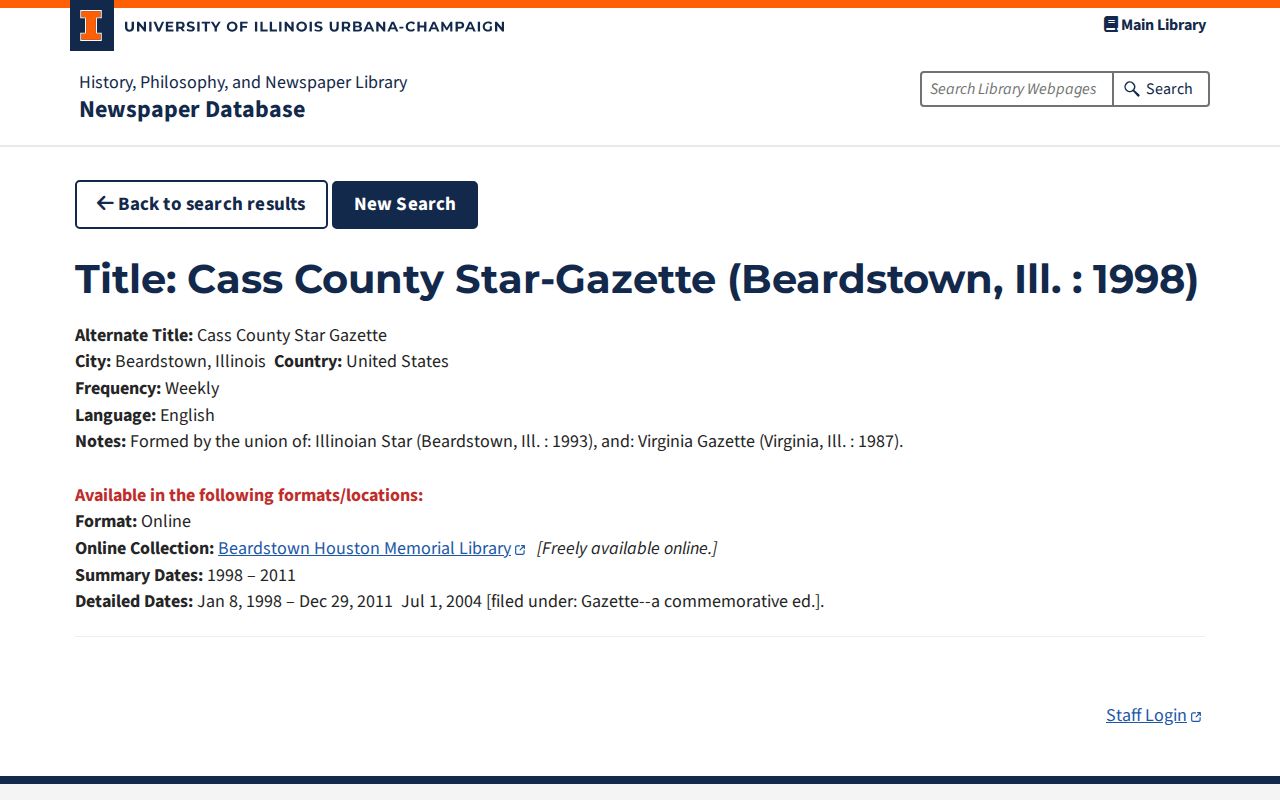
That record is best treated as a doorway into local newspaper history. Keep it apart from current police and jail data. Need an official arrest or transport record? File a focused FOIA request with the agency that created it. Name a date range. Identify the person or incident clearly enough for staff to search. If you learn which jail received the person, ask that facility. Request its booking sheet. Request any booking photo it holds. Illinois law gives offices no such duty. It does not force an office to build a custom arrest log it never kept. Court history runs on a separate track. The Cass County Circuit Court Clerk explains that pre-1998 records sit in book indexes. Newer ones are computerized. They are open at a public terminal and searchable through Judici. Juvenile files, impounded material, and other protected records stay restricted. This route can show how a Cass County case resolved after the news moved on. Older county records sometimes transfer to the Illinois Regional Archives Depository. Cass County falls under the University of Illinois at Springfield depository. No current booking-photo collection for the county is listed there. Ask by office, series, and date. Do not request a generic arrest archive. Note: No published Cass retention period guarantees how long an arrest report, transport record, booking sheet, or booking photograph remains available.
Cass Arrest Reports Need Court Checks
An arrest log entry only marks the start of a case. Charges can change later. They may be reduced, dismissed, or amended entirely. A picture printed beside an article is not automatically a booking image.
Judici’s Cass case search gives you a starting point online. The Circuit Clerk’s record remains the authority. Judici itself notes that it runs outside the court system. Enter dates and identifiers carefully, because common names produce false matches. Old articles add another wrinkle. A result may carry the year in its URL, or the page may have been refreshed, while the story text holds the real report date. Note the arrest date and the publication date when both appear. If only one shows up, never guess the other. An outside jail named in an old Cass County item deserves the same skepticism, since a past lodging arrangement says nothing about detention today.
Each source plays its own role. The arresting agency writes the report. The receiving jail keeps the booking record. A newspaper simply summarizes what happened. The Circuit Clerk holds the court case. Archives preserve transferred records where applicable. Follow that order and a multi-day news trail stays useful. It is a trail of leads, though, not a master log of Cass County arrests.
Corrections start at the source. That means the office that created the disputed fact. Bring the record identifier, the date, and the exact field in question. Then show the publisher the corrected official record. One caution applies here too. An old headline can stay indexed long after a court result shifts, so always read the current disposition before drawing any conclusion.
A thorough search often ends with several documents rather than one screen. The article is your dated lead. The agency report covers the event. The outside jail entry documents the booking. The court file settles the outcome. When sources conflict, note when each was made and ask the official custodian to resolve the field in dispute. That approach protects the timeline. It also keeps an old police item from turning into a claim about who is in custody now.
The Cass FOIA form covers most of what a requester needs. You can describe the record, choose electronic or paper copies, name a format, and address fees or a waiver. Use it for a defined sheriff record. An open-ended compilation request tends to fail. A municipal police report belongs with that city. A booking sheet from another county belongs there too. Route each request to its creator, since a blotter mention alone does not make every document a Cass Sheriff record.